What to consider before varying or terminating a legal agreement in Australia

Not sure what to ask?
Try one of these smart suggestions! Every answer is tailored to you.


What is varying or terminating a legal agreement?
Varying or terminating a legal agreement refers to formally changing (vary) or cancelling (terminate) an existing legal agreement under Australian family law. This applies to agreements like prenups and postnups (Binding Financial Agreements), cohabitation agreements, and separation agreements.
Under the Family Law Act 1975, these agreements must be varied or terminated through a new signed agreement that requires independent legal advice for both parties. You cannot simply ignore or informally change these agreements, as this may create legal complications and the original agreement may still be enforceable.
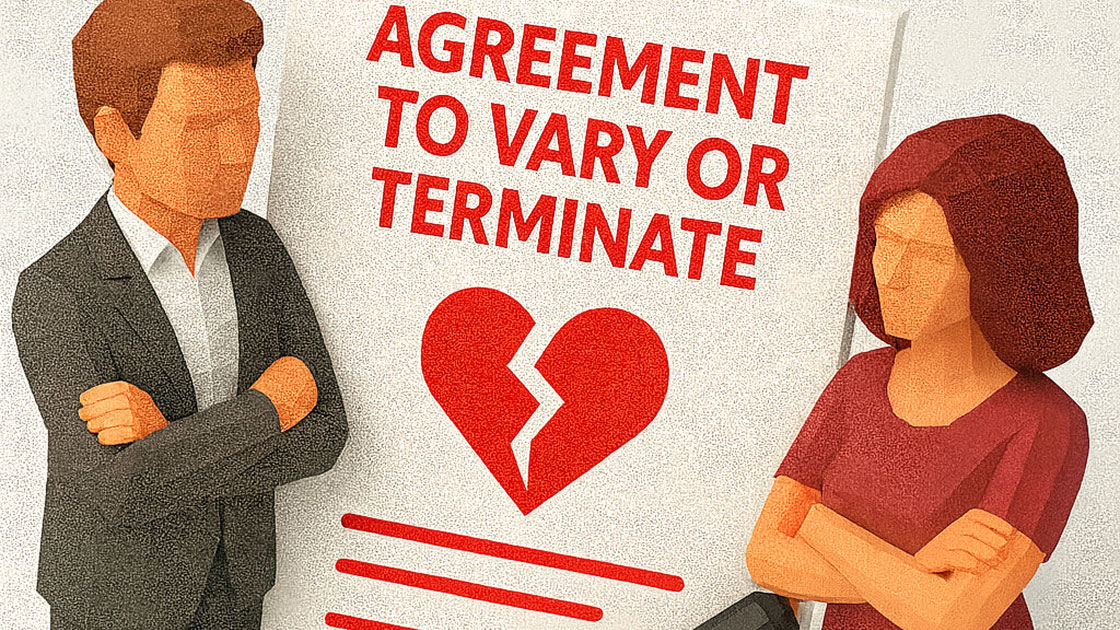
Key benefits of properly varying or terminating agreements
Keeping agreements up to date as life changes helps avoid legal risks from outdated or unfair terms. Whether you've had children, changed careers, inherited assets, or reconciled after separation, updating your agreements ensures they reflect your current reality.
Properly varying or terminating agreements reduces future conflict by ensuring both parties agree in writing to any changes. It prevents courts from setting aside informal changes and ensures enforceability through proper legal process. This gives both parties certainty about their legal position.
How LawConnect can help with varying or terminating your agreement
Our AI legal assistant can answer your questions instantly about how to cancel a prenup, whether a new agreement is required, or how variations work under the Family Law Act. Get personalised information about your situation, available 24/7.
If you're in Australia, we can also connect you with a licensed family lawyer who can draft a new agreement, review a termination, ensure full legal compliance with the Family Law Act, and help protect your interests throughout the process.
Common scenarios we help with:
You and your partner reconciled and want to cancel your BFA
You divorced and need to revise your property agreement
You want to change spousal support or parenting terms
One of you inherited new assets not covered by the original agreement
Not sure what to ask?
Try one of these smart suggestions! Every answer is tailored to you.

Frequently Asked Questions

Yes, you can vary a Binding Financial Agreement after signing, but you need a new written agreement that complies with the Family Law Act. Both parties must receive independent legal advice and the variation must be properly executed. You cannot simply make informal changes or verbal agreements to modify a BFA. Our AI legal assistant can explain the variation process, and we can connect you with a qualified family lawyer to help draft the variation properly.
To terminate a BFA, you need to create a formal termination agreement that follows Family Law Act requirements. Both parties must receive independent legal advice and sign the termination agreement. The termination must be in writing and properly witnessed. Once properly terminated, the original agreement is no longer enforceable. Our AI legal assistant can help you understand the termination process.
Yes, you can change the terms through a variation agreement that must be properly prepared with independent legal advice for both parties. The variation agreement essentially creates new terms that replace the old ones. All Family Law Act requirements must be met for the variation to be enforceable. We can connect you with experienced family lawyers who specialise in varying BFAs.
Yes, both parties must consent and sign any variation or termination agreement. One party cannot unilaterally change or cancel a BFA. If one party doesn't agree to changes, the original agreement remains in effect. If there are disputes about changing the agreement, court intervention may be necessary.
Yes, you can terminate these agreements with a proper termination agreement or create a new agreement that replaces the old one. The same principles apply as for BFAs if the agreement was made as a Binding Financial Agreement. Both parties must consent and receive independent legal advice for the termination to be effective.
You can only withdraw through proper legal processes like variation or termination, and both parties must consent. Simply withdrawing unilaterally or ignoring the agreement doesn't make it go away. The agreement remains legally binding until properly varied or terminated. Our AI legal assistant can explain your options based on your specific situation.
Draft a variation agreement that complies with the Family Law Act, with both parties receiving independent legal advice from separate lawyers. The variation must be in writing, properly signed, and witnessed. The lawyers must provide certificates confirming they've given advice about the variation. This creates a legally enforceable change to your original agreement. We can connect you with family lawyers experienced in agreement variations.
Courts can set aside agreements that are unfair or improperly made, but they cannot vary the terms of a valid BFA. If a court sets aside an agreement, it becomes invalid and property division reverts to Family Law Act principles. Courts will consider factors like whether both parties had legal advice and whether the agreement remains fair in current circumstances.
Yes, you need a formal variation agreement to legally change an existing BFA or other family law agreement. The variation agreement must meet the same legal requirements as the original agreement, including independent legal advice. Informal changes or verbal agreements won't be legally recognised and may create confusion about what terms actually apply.
Informal changes aren't legally binding and may create confusion or disputes later. If you make changes without proper legal process, the original agreement may still be enforceable, or courts might not recognise any changes. Property division could become uncertain, leading to expensive court battles. Our AI legal assistant can help you understand the risks, and we can connect you with a lawyer to ensure changes are made properly.
A valid variation or termination must be in writing, signed by both parties, include independent legal advice certificates, and be properly witnessed. Both parties must fully understand the changes and their implications. The agreement should be fair and entered into voluntarily without pressure. Courts are more likely to enforce variations that follow proper legal procedures.
Yes, significant changes in circumstances can affect whether courts will enforce an agreement. Changes like having children, major changes in income, or long-term disability might make an agreement unfair to enforce. However, the proper way to address this is through a variation or termination agreement, not by ignoring the original agreement. Our AI legal assistant can help you understand when circumstances might affect your agreement.